
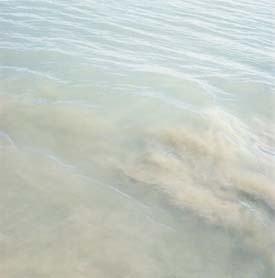
Churn (2006) Sonja Thomsen. Courtesy the artist.
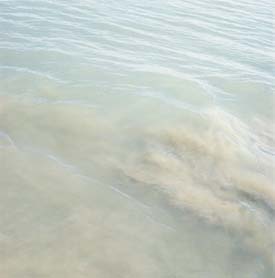
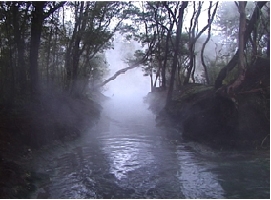
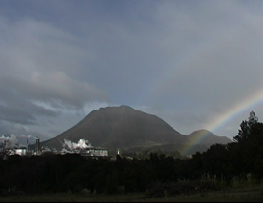
Still from the video installation Uncle Tasman: The Trembling Current That Scars the Earth (2006), Natalie Robertson, an artist participant in the PRNMS. Courtesy of the artist.
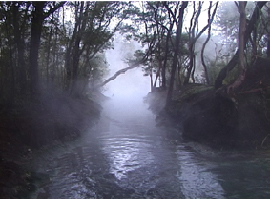
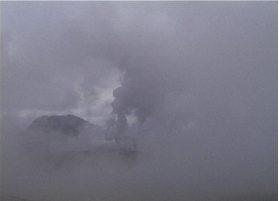
Still from the video installation Uncle Tasman: The Trembling Current That Scars the Earth (2006), Natalie Robertson. Courtesy of the artist.
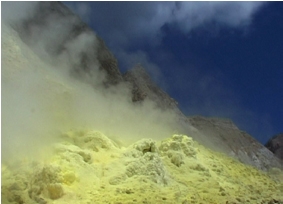
Still from the video installation Uncle Tasman: The Trembling Current That Scars the Earth (2006), Natalie Robertson. Courtesy of the artist.

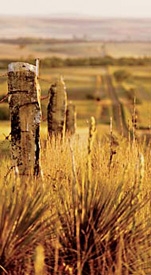
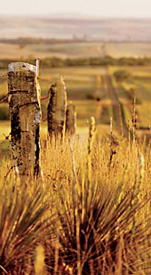
Post Rock fence. Photo courtesy of Kansas Travel and Tourism Bureau
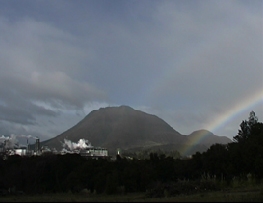
Still from the video installation Uncle Tasman: The Trembling Current That Scars the Earth (2006), Natalie Robertson. Courtesy of the artist.
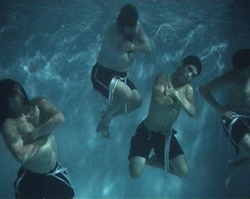
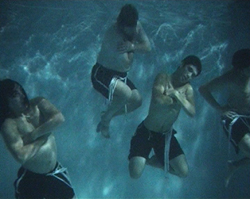
Rerehiko (2003) Rachael Rakena.
Feature: Essays
Pacific Rim Summit
From the seven days we logged at the ISEA/Zero One festival, we’ve brought you two short takes from the Pacific Rim New Media Summit (PRNMS) co-sponsored by the CADRE Laboratory for New Media and Leonardo/ISAST. One of three invitation-only summit meetings preceding ISEA/Zero One proper, PRNMS gathered artists, curators, educators, and scholars for intense discussion about defining and deploying new media. All the summits attempted to create a context for the festival; to deepen it and, perhaps one could say, “make it hold water.”
TAKE ONE: SKIN, EDGE, RIM
Stephanie Ellis
ISEA partnered with ZeroOne; on their joint Web site, the event was billed as both an “intersection” and an “epicenter” of art and digital culture.
On first read, this claim to be both a meeting point and the center of a shock wave, a coming together and a catastrophic displacement seemed like a poor mix of metaphors…a kind of banal exaggeration typical of boosterism.
On the same shared website, ZeroOne called itself “a global festival of art on the EDGE” and the ISEA summit that Meredith and I attended was called “Pacific RIM.” How might these two keywords (edge + rim) that tend to collapse into one another and these two key movements (meeting + dispersing), that appear as oppositional forces, be figured?
Three possibilities:
SKIN
You and I move because our muscles move. Muscles move because the permeable membranes that surround our muscle cells allow mineral salts to move back and forth. In a kind of alchemy, the coming and going of salts are triggers or catalysts for action. All of our cells, not just those muscle cells, are tiny seas, anywhere from 65 to 90 percent salty water. Our bodies are sacks or envelopes of sea that moved onto land.
Interestingly, Freud, whose writings are foundational to the theories of psychoanalysis, first studied the hydraulics of the body. Even though his lifelong focus was on the psychic or emotional body, he often borrowed plumbing metaphors common to turn of the century models for the somatic or physical body. So contrary to everyday wisdom that the ego is at the core or center of one’s identity, Freud described the ego as a skin — as a permeable membrane at the periphery between self and other.
Freud describes psychic trauma or shock as a process of fragmentation and repression of memories that the conscious mind cannot bear or tolerate. Repression is often imagined as the bad stuff thrown under the bed, hence the older term — sub-conscious. But the geography of repression is more complex. Shock can, for instance, be pushed horizontally to the edges or rim of the body. In severe shock this feels like being skinned alive, flayed or as Julia Kristeva has said — excoriated.
Milder forms of shock or surprise — such as listening to a ghost story — register as goose bumps and hair standing up on end. Shamans or healers have been known to read their own goose bumps as a kind of trauma meter, to get a sense of how serious a patient’s injury might be. Horror is from the root word horrere, which is Latin for “stand on end.” Fear, awe, anger and also intense pleasure can initiate this uncontrollable sign-making at the periphery or rim of our bodies.
RIM
The Pacific Rim Summit was a year-long effort by workgroups of artists and theorists from a mix of locations around the Pacific. The summit was an opportunity for face-to-face contact among members, many of whom had only met on-line. The summit was an opportunity to meet in person, in the flesh and, more critically, to practice a new subjectivity inspired by the summit’s self-appointment to incarnate this Rim. What would it mean to show up as a citizen of the Rim?
The Pacific Ocean is often pictured, on actual and mental maps, as a kind of large blank or gap between terra locations that matter. The title of the summit re-imagines the Pacific as enveloped by an edge or skin — as a body or presence and therefore a location that matters or holds water, so to speak. Ideally this rim or skin of the Pacific is permeable, the site of comings and goings, the movement of practices and collaborations that serve as catalysts for larger actions. These actions in turn sustain a collective body, imagination and affect. This Pacific figures as a utopic dream, standing in for a new global body.
Here lies a caution — to not mistake expressions of the utopic and catalytic (the world we want) with expressions of the dystopic and catastrophic (the world we have been given). The Pacific Ocean is known as the Ocean of Peace in more than one language yet the atomic explosions at Hiroshima and Bikini, the epic volcanic and earthquake activity and ensuing tsunamis — all demonstrate that the Pacific Rim registers (like goose bumps) some of the world’s most severe shocks.
At the Pacific Rim summit, the face-to-face meeting was a celebration and a failure. The lack of faces of color at the summit had everything to do with economic inequality, the related war on terrorism and the prioritizing of local agendas and politics. Picturing a rim as a coming around or meeting shifts the relationship of figure and ground, and makes visible a new global imagination. Equally, such a rim is evidence of shock waves that exceed our present capacity or will to articulate.
EDGE
ZeroOne, the global festival of art “on the edge” can and cannot be collapsed into the same as “art on the rim.” If art on the edge is a return to art as oracle, as avant-garde — a shop-worn notion that positions art as both outside and ahead of history — then Electronic Arts (setting itself apart as art of the latest media) is merely complicit with a dominant myth that technology determines culture. Wielding prophecy like a razor, a knife, a cutting edge is, I suggest, self-mutilation, an attempt to distract the self from the pain of a future already turned fossil.
On the other hand, art on the edge could be art at its limits, at the moment and site of its breakdown and the beginning of something radically other. Art on the edge is not determined by its medium but rather by its potential to be a screen on which to project a utopic global presence, a radical peace — as well as (and this is crucial) — a site of reckoning.
Toni Morrison in her novel Beloved describes “reckoning” as the practice of publicly acknowledging and collectively dealing with our own ghosts as well as the ghosts of our ghosts. In Avery Gordon’s reading of Morrison’s text she refers to ghosts as the unspeakable pasts that makes the present waver. Ghosts are shock waves or disturbances in the ether and the depths that register our catastrophic displacements and dispersals. Public and collective are the key terms for our personal ghosts are themselves haunted by social ghosts.
Art on the edge (in this sense of art at its limits) breaks down in order to “flesh out” our dreams as well as to “get the skinny” on our nightmares.
TAKE TWO: OCEANS COME AND OCEANS GO
Meredith Tromble
The barbed wire that kept the cattle in my grandfather’s Kansas pastures was strung on pink limestone posts, decorated like exuberant Rococo frames with fossil shells. I grew up with these ancient sea creatures, but I didn’t see a living ocean until I was a grown woman and came to California.
There must have been a scintilla of Pacific salt in the air of our Pacific Rim Summit meeting room. But the waters were just as invisible as if we’d been in Kansas. Our group of seventy-plus people gathered from Asia, Australia, Europe, North and South America, and the South Pacific ignored the living ocean that shapes the “Rim.” Though we were Immersed in oceanic metaphors of surfing, flow, and navigation, the Pacific seemed to be the negative space in which the figure of the “Rim” appeared. We overlooked the body of our virtual world, reveling in its dreams.
To say that the virtual world is disembodied is to forget the turbines and dams, the coils and magnets, the metals and plastics through which it manifests. It “terrorizes” us to recall this, to know our vulnerability to bombs, blackouts, and tsunamis. To discuss the Rim without discussing the Pacific…this was business as usual. But bodies have ways of reminding minds that they exist.
Six hundred miles to the north of San Jose and a short distance from the Oregon Coast is a growing dead space in the Pacific. The area off Cape Perpetua is now a gigantic crab and fish graveyard with a level of dissolved oxygen 10 to 30 times lower than normal.
In May, Dr. Rudolf Wu and his colleagues at the City University of Hong Kong published a paper in Environmental Science & Technology (the journal of the American Chemical Society) in which they concluded that dead zones are developing along the coasts of the major continents and spreading over larger areas of the sea floor. The United Nations Environmental Programme estimates nearly 150 permanent and recurring dead zones exist worldwide, primarily caused by agricultural run-off and discharge of domestic and industrial wastewaters. Oceanic “live zones,” of course, are the foundation of the Earth’s food chain, sustaining life both in and out of the water.
In one of the discussions that erupted at the Summit, Maori artist Natalie Robertson began to talk about regarding the Pacific Ocean as a “whenua,” a land, with islands as the home base. Talk flowed around that notion and moved on, but it might have been one of the most germinal ideas to surface in the entire summit.
What would it mean to know the ocean as a “land”? In A People’s History of Science, Clifford D. Conner gives an example of specificity with which Oceanic cultures understood their waters. Pacific Islanders, he says, could navigate in the open ocean by reading the swells. “An ocean swell might be thought of as an ‘old wave,’” he explains, “It does not crest; it has a longer, slower undulation…Because the winds of the Pacific follow regular, predictable patterns, the ocean swells that those winds created are also predictable over large areas of the open sea. An experienced navigator can detect the direction of the swells by the way the canoe pitches and rolls and can determine sailing direction by relating it to that of the known direction of the swells…[swells] also provided a means of detecting the presence of land before it came into view. When a navigator begins to notice the characteristic patterns of reflected or refracted swells, it is an indication that land is nearby.” (55)
In the final PRNMS session, the Raqs Media Collective presented a set of questions for the future in which they picked up the notion of Oceanic navigation as a guiding metaphor for digital communities. But very few works encountered at ISEA/Zero One contained even a hint of of how such a metaphor might be embodied. The most thought-provoking installation in this regard may have been Rerehiko, by Maori artist Rachael Rakena, although this potential wasn’t evident from Rakena’s artist statement. Rerehiko, shown as part of the “Container Culture” exhibition orchestrated by the Curatorial Working Group of the PRNMS, was a two-channel video projection inside a shipping container. Flickering images of people bobbing under water almost created the illusion that the container was “inside out” — holding water rather than protecting from it. Blue light filled the space; the submerged “swimmers” struggled against the water’s motion, their own buoyancy, and their need for air to remain “stationary” in front of the camera.
In her statement, Rakena spoke of “Using the metaphor of sea/water…as a specifically non-land-based place like cyberspace, text and body float within this undifferentiated and amniotic space.” This text is written in the old language of cyberspace as a disembodied world. But Rakena’s image opens other volumes. Rerehiko could also be interpreted as a turning of attention to humanity’s perilous, unstable position in this “physical” world which is also a “virtual” world, remaining alive to this condition despite the considerable exertion awareness requires.
Oceans come and oceans go. We can and do take our ocean for granted. But when it goes, we go.
