
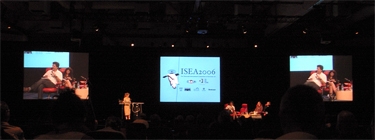
Sara Diamond addresses the ISEA audience; the image of Diamond's fellow panelist Trebor Schulz is projected. ISEA 2006 Symposium, Community Domain Panel 1, Tech Museum, San Jose, CA. Photo copyright C. Robbins, 2006

WorldProcessor (1988-2006), Ingo Gunther, detail of installation, San Jose Museum of Art. Copyright C. Robbins, 2006

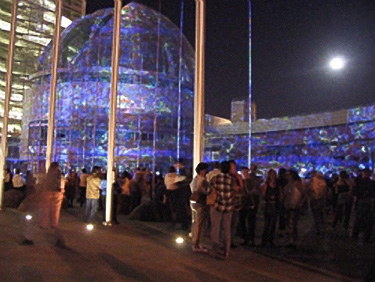
Digital Kakejiku (2006) Akira Hasegawa, projection on San Jose City Hall
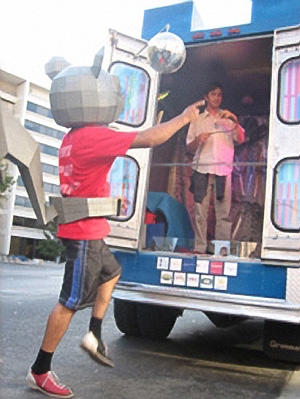
Squirrel-costumed driver of Karaoke Ice truck
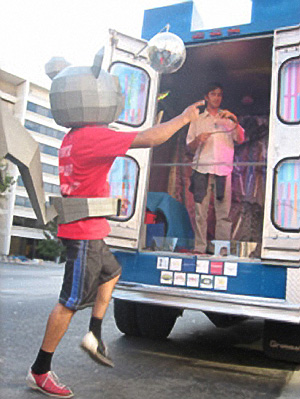
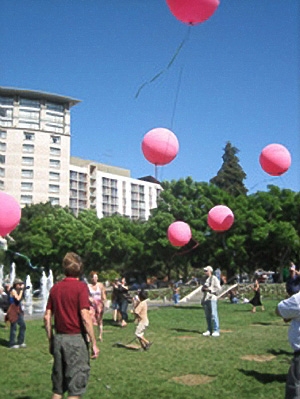
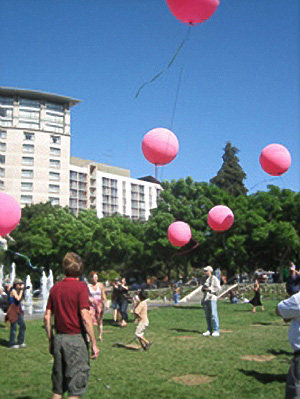
99 Red Balloons (2006), Jenny Marketou and Katie Salen
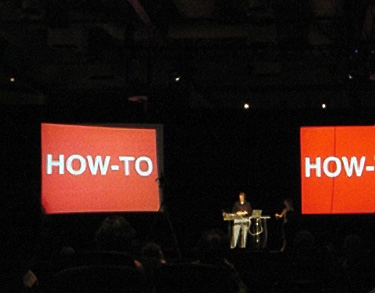
Kevin Hamilton's presentation at Community Domain Panel 1. Photo copyright C. Robbins, 2006

Feature: Reviews
Assessing ISEA 2006
Christiane Robbins originally delivered the remarks that follow as one of the panelists at “Assessing ISEA/Zero One,” an evening of discussion hosted September 19 by the Design + Technology Department of the San Francisco Art Institute (SFAI). Robbins and her fellow panelists Beatriz da Costa, Hou Hanrou, and Joel Slayton engaged a crowd of more than 150 people eager to talk about the successes, failures, and conundrums of the August, 2006 gathering of electronic art and artists in San Jose, California.
Robbins is an artist, director and professor whose mutable practice focuses upon cross-disciplinary digital media, installation and locative public space projects. Her works is internationally recognized and is included in numerous public collections including the Stedelijk Museum (Amsterdam), Museum of Modern Art (New York), the Getty Museum (Los Angeles), the Kitchen (New York), the Banff Centre for the Arts, and the San Francisco Museum of Modern Art, among others. The beta installation of her most recent project, “I-5_Passing” is included in Part One of the exhibition “Edge Condition” at the San Jose Museum of Art through November 26, 2006.
She received her MFA from CalArts and is an Associate Professor at University of Southern California (USC), a Visiting Scholar at Stanford University and former Director of the MATRIX Program of Digital Media. Robbins’ programming/curatorial practice was most recently embodied when she served as a co-organizer of USC / MIT’s bi-annual conference Race in Digital Space (a multi-year initiative supported by the Annenberg Center for Communication and the Ford and Rockefeller Foundations) and by her position as Executive Producer for the AIM Festival for Time-based Media hosted by USC in collaboration with MOCA and the Santa Monica Museum of Art. She is also a principal of Jetztzeit, a studio researching and developing projects and issues critical to the negotiation of visual culture and digital media practice.
Christiane Robbins: Iíve come here this evening not to assess ISEA 2006 as such. I’ve come to offer my opinion — my opinion as an artist who was selected for the Transvergence category of ISEA, as a juror for ISEA, as a cultural producer who has programmed and produced a number of symposiums and conferences addressing various aspects of visual art and media practices, and as an artist-citizen. Iíve come here to participate in a conversation — which reflects an on-going online conversation — that is in keeping with the maturation of this field of new media, digital media, or whatever tag you’d like to attach. This maturation — a questioning of the evolving relationship in what has been defined as new media and what has been defined as visual art and cinematic practice within the realm of post-studio practice — during a time of global warfare — was in full evidence during the ISEA /Zero One Festival in San Jose last month. And certainly this has since had a sustained afterlife in the blogosphere in lists such as IDC and Empyre. Such maturation necessitates change… and change implies conflict… and that is where the field finds itself today: within this terrain of debate where issues are held in tension. However, the key here is that they be held in a productive tension rather disappearing under the weight of their own contestations.
As we’ve seen already this evening, there has been a good deal of chatter about the ISEA event, well-founded compliments as well as criticisms. The very fact that we are all here and engaged in this conversation speaks to an open reception by SFAI and the organizers which is not only welcome but recognized as necessary to the evolution of the field.
Let’s not forget that this was the inaugural event of the Zero One Festival, which resulted in a robust, ambitious and significant event which brought together the city of San Jose in an unprecedented way. Some writers in the press have already alluded to the power of the popular cultural transformation attributed to the impact of this festival on the City of San Jose.
“For a brief, digitally charged moment — OK, for seven days — the ZeroOne festival turned San Jose into the nation’s art and technology capital. Beyond that, “ZeroOne San Jose: A Global Festival of Art on the Edge’’ helped lay the groundwork for “branding’’ the city as a digital arts mecca, said Dan Keegan, executive director of the San Jose Museum of Art. By the time the smoke had dissipated and the monitors were unplugged, the festival had drawn an estimated 50,000 people and generated attention from around the world.”
— Mark deLaVina, San Jose Mercury News, Aug.15, 2006
This was a festival created through the partnership of San Jose Convention and Tourists Bureau, the City of San Jose, San Jose State University, the Cadre Institute, the San Jose Museum of Art, Zero One — the organization — The Tech Museum and the Cultural Initiative of San Jose. I delineate this partnership, this infrastructure, not to bore you endlessly with bureaucratic nuance, but rather to point to a crucial element in our consideration of what has transpired not only here, but also, I suspect, elsewhere in one form or another.
The partnership points to a much larger issue and that has to do with the implications of the increasing privatization of culture and plutocratic persona of the U.S. today. And, perhaps, this can be realized more clearly through the feedback offered by those outside the U.S. Those of us living in the U.S. today have taken on a peculiar liminal character of what we once were (at least what I remember Ö and that, of course, is contingent on a very suspect memory bank!). The mirror held up by our colleagues abroad is paramount, not only to our individual and collaborative practices but to what our culture as a whole is becoming: a flat-space culture. By Sheppard and White’s definition a “flat-space culture” is 1) an intensified space, which is corporate and hyper-efficient; and 2) an “indie” game for Microsoft utilizing 3D graphics with a top-down view and where PLAY is notably open-ended. Activities available include trading, missions, exploration, bounty hunting, space piracy and police work.
Notions of play
“Play” was an ubiquitous term permeating all branding of ISEA/Zero One. It is also a notion which has generated much discussion. On the IDC list Daniel Perlin’s incisive statement resonates: ” Sure, play can be fun. But just because it’s fun, doesn’t make it play. And just because you track something on GPS, that doesn’t make it play or fun, for that matter.
Every missile fired from and to Iraq is tracked too. And for some in power plays, this “Iraq thing” is just a playground as well. Am I alone in begging my fellow makers of things to please ask the question: “Who controls what and why?”
By way of disclaimer, I did my obligatory stint in non-profits and, in fact, directed the NEA’s Regional Regranting Program for Individual Artist Fellowships at the time it was excised from our national consciousness in 1995 by Congress. We need to acknowledge that the not-for-profit sector came to exist, at least in part, to support alternative artistic practices and important work that could not be sustained by audience demand or corporate donations alone. To be frank, most of what I’ve found inspirational in contemporary art practices could not have been generated in the for-profit sector. Indeed, a huge percentage of what I appreciate in the for-profit sector would not exist if the not-for profit sector had not laid a foundation ofí sustained support to create and produce such seminal work. If the non-for-profit sector had not thrived (arguably!) in the 1970’s and 1980’s, I have my doubts that Bill Viola’s work would have had the opportunity to be so honored at the Commonwealth Club during ISEA 2006.
Yes, cultural positioning of the artist as migratory R&D worker
Consequently, I would argue that THE critical question for the arts — any art practice — but specifically for this discussion the digital arts/media, and for foundations that support the arts, is how artists and arts institutions that produce work deemed too difficult or too taxing to be recognized or appreciated by the market-based system are to be educated, nurtured, and sustained as valued markers of a priceless cultural moment. Survival Research Labs, which performed at ISEA, is a prime example of such a cultural marker coming out of the 1980’s punk/club scene ... who some said was an acquired taste ... but is now a mainstay of the techno arts scene.
The original proposal submitted by Zero One to the ISEA Board, “Silicon Transvergence,” stated that “the San Jose team distinctly addresses themes of culture, business, the arts, and academia, suggesting the potential for unique interaction between all of these sectors. … ” This is a laudable ambition to be sure and one that has been bandied about in funding circles for quite some time. Their statement was supplemented by this quote from San Jose’s Mayor, Ron Gonzalez:
This conference is ideally suited to San Jose because we are an established global center of technology, innovation and entrepreneurial enterprise.
In other words, welcome to the mutated, privatized realm of cultural practice in twenty-first century U.S.A.
Ethics of community making
Within this realm, notions of community or “community domain” have become problematized as a matter of “surface framings” in such a context of “culture, business, the arts, and academia.” Surface framings are rendered meaningless in a nanosecond when they are not accompanied by the requisite deep framing of issues, when they are not accompanied by deep moral convictions and principles applied at both the surface and deeper levels in order to maintain some integrity in what we put forth. Following her moderation of one of two panels on community domain, Sara Diamond reflectively asked these resonating questions:
If we act as context providers in relation to “community” what questions do we ask? What histories do we refuse and why? What happens to the histories of violence, shame, and racism — of truth and reconciliation — to the city building project? What is our responsibility in unearthing histories to their sources? What is the role of monumentalizing, for whom, to what? What are the ethics of contemporary community making?
On the other hand, in turning my attention to ISEA , the organization (a community maker, itself) it is critical to consider the words of Nina Czegledy in response to Michael Naimark’s request to hear from members of ISEA’s Board in response to some questioning feedback being levied on the IDC List. She stated:
Comparisons are difficult in the case of the nomadic ISEA events. Each and every time, a fresh team of organizers conceive and develop the symposia, grounded in local context. On one hand — in addition to providing impetus for local and regional participants — this method produces ongoing change of form and venue, at the same time the nomadic factor mitigates against continuity.
Nina’s statement could be construed in one very real way as a constitutive question of identity, a problem of identity stabilization for the ISEA organization itself. Who is ISEA really and where is the clarity that must be fostered as a core belief system from which the local and regional participants work? This is for the members of ISEA — not only the Board of Directors — to fully address and grapple with.
As is common in the arts in most non-commercial realms of cultural production the question is funding. From working briefly with ISEA at USC, I am somewhat familiar with their financial concerns. As such, I realize that their selections of conference sites are, in large part, based on the pragmatic considerations of financial enticements offered by a potential host venue. In this case, the bid from San Jose made the ultimate good sense and was mutually beneficial to ISEA and the nascent Zero One Festival.
Framing the future
When ISEA 2006 first came across my radar screen, I was captivated by the category of Interactive City. This, of course, hinged on my own practice, which has been dealing with these issues for the past six or seven years. The introductory page for the Interactive City Summit used a pull quote from J. G. Ballard:
I would sum up my fear about the future in one word: boring. And thatís my fear: that everything has happened; nothing exciting or new or interesting is ever going to happen again. The future is just going to be a vast, conforming suburb of the soul.
And this will be my last point in this limited time frame —and again I return to looking NOT at the individuated realm ISEA/Zero One — as, without doubt, there were incredible moments which spoke to the overwhelming commitment, distinction and intent of the organizers.
Rather I am referring to ISEA/Zero One as a point of departure to riff on where we are today in the States, to reflect on our international colleaguesís mirror of the States in the early twenty-first century. My fear is that the future is just going to be a “vast, conforming suburb of the soul.”
In closing, I wanted to offer you the abbreviated sentiments of artist Danny Butt of New Zealand from a post on the Empyre list:
If we’re telling stories where the politics are worked out “in advance,” where the political effectiveness of our gestures is somehow guaranteed, I think we’re in a space which is unable to grow its imagination, and such a space will ultimately be hostile to the creation of art.
It is up to us, everyone in this room, to rediscover our sense of agency, our sense of imagination, and our sense of purpose, because we’ve been orbiting around in our hermetically sealed selves so long that weëve become dizzy. We no longer recognize ourselves for who we may become.
Let’s keep the conversation going.
Copyright Christiane Robbins, all rights reserved.
