
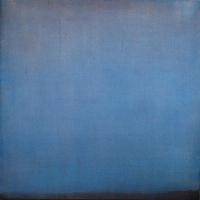
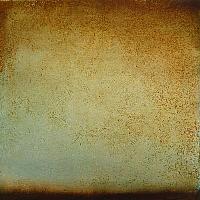
Landscape 45 06 (2006)
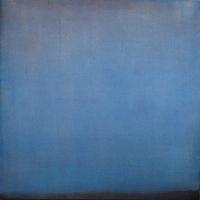
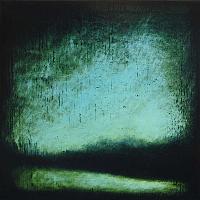
Landscape 26 06 (2006
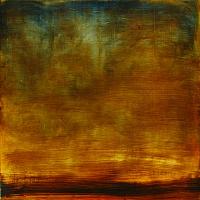
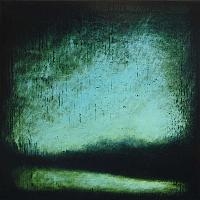
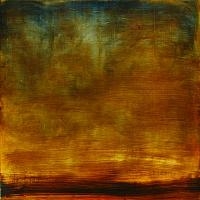
Landscape 41 06 (2006)
Feature: Reviews
David Ivan Clark, Paintings
- Spur Projects
- Portola Valley
- October 19 - November 22, 2006
Oakland artist David Ivan Clark is currently offering a suite of new paintings as part of a group show with Ann Hogle, Ashlee Ferlito, and Melissa Day. Clark has been known in shows over several years in San Francisco as a painter of landscape based meditations that evoke the industrial manipulation of nature. His works raise the question of whether there can exist a pure vision of the natural apart from the stamp of human intention, while paradoxically depicting a vastness of land and sky that flatly seem impossible to constrain. He had often studded his surfaces, which are made of stainless steel sheet metal, with a border of nails or rivets suggesting the mandate of productivity amidst the vastness depicted. In this show, his focus has subtly shifted from border to screen, with the visual emphasis on painterly grandeur and its artifice.
Clark’s working method begins with a carefully built up ground coat on a steel surface, over which he applies multiple layers of pigment which are in turn sanded or otherwise abraded, so that a series of ridges appear from surface anomalies of the ground along with layers of paint in varying degrees of revelation. Both color and surface contrive to give the effect of landscape, often as if seen through a screen or grid emerging from the ground to become the structure of the image. Sometimes the grid is as faint as a light drizzle and at others, it becomes the dominant pictorial element. Because of its propensity for surprise and happy accidents, it’s a process that produces an abundance of pleasure in this artist’s hands, and here he has pushed its effects to impressive new dimensions.
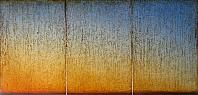
Landscape 51 06 is a rectangular triptych measuring 132 inches by 64 inches, a commanding work whose vertical striations emphasize the panels’ stolid presence with all the visual formality of a Japanese screen. It is a painting that sits on the border of depiction, an oblique homage of traditional landscape painting and its illusions, though reduced in Clark’s reckoning to such minimal trappings as to push the genre toward abstraction. Its effect combines a fiery, brilliant light with the calculated repetition of its forms.
It may be that Clark’s paintings more dispassionately celebrate nature the further they stray from philosophical underpinnings. There is Landscape 26 06, a lush and roiling vision with its hints of apocalypse where the sky emerges behind a curtain of almost theatrical atmospherics, towering and primordial. There are landscapes and effects of light that defy any sense of place, (some of them would more accurately be called dreamscapes) where an elegiac tone is struck that has its antecedent in Romanticism, but whose flip side is impermanence. In Clark’s most overtly landscape-oriented work is the urge to break the bonds of representation and make manifest the consciousness of seeing itself, but in painting, of course, there is no seeing without the nostalgia of the pictorial, what Harold Bloom has called the “anxiety of influence.”
This nostalgia finds its visual equivalent in the screen which serves as a kind of filtering device between viewer and image and causes one to remain aware of how pictorialism is haunted by historical precedent. There is a strong visionary component in Clark’s pictures as well; in some there is an emptiness and finality that looks like the end of time, in others you have the sense of things seen, but clouded by memory, images of another world that might resemble this one.
Then there is Landscape 41 06, where an obscure bluish cloud or sky is surrounded by chiaroscuro void, hovering over a shrouded body of water; the water receives its light from that sky, whatever light it can retain before the blackness of night descends on all. It is a sublime painting whose surface is perfectly smooth and bears little trace of whatever toil it may have taken to arrive at it, a vision of no time and no space, whose beauty astonishes us and then is gone in an instant.
